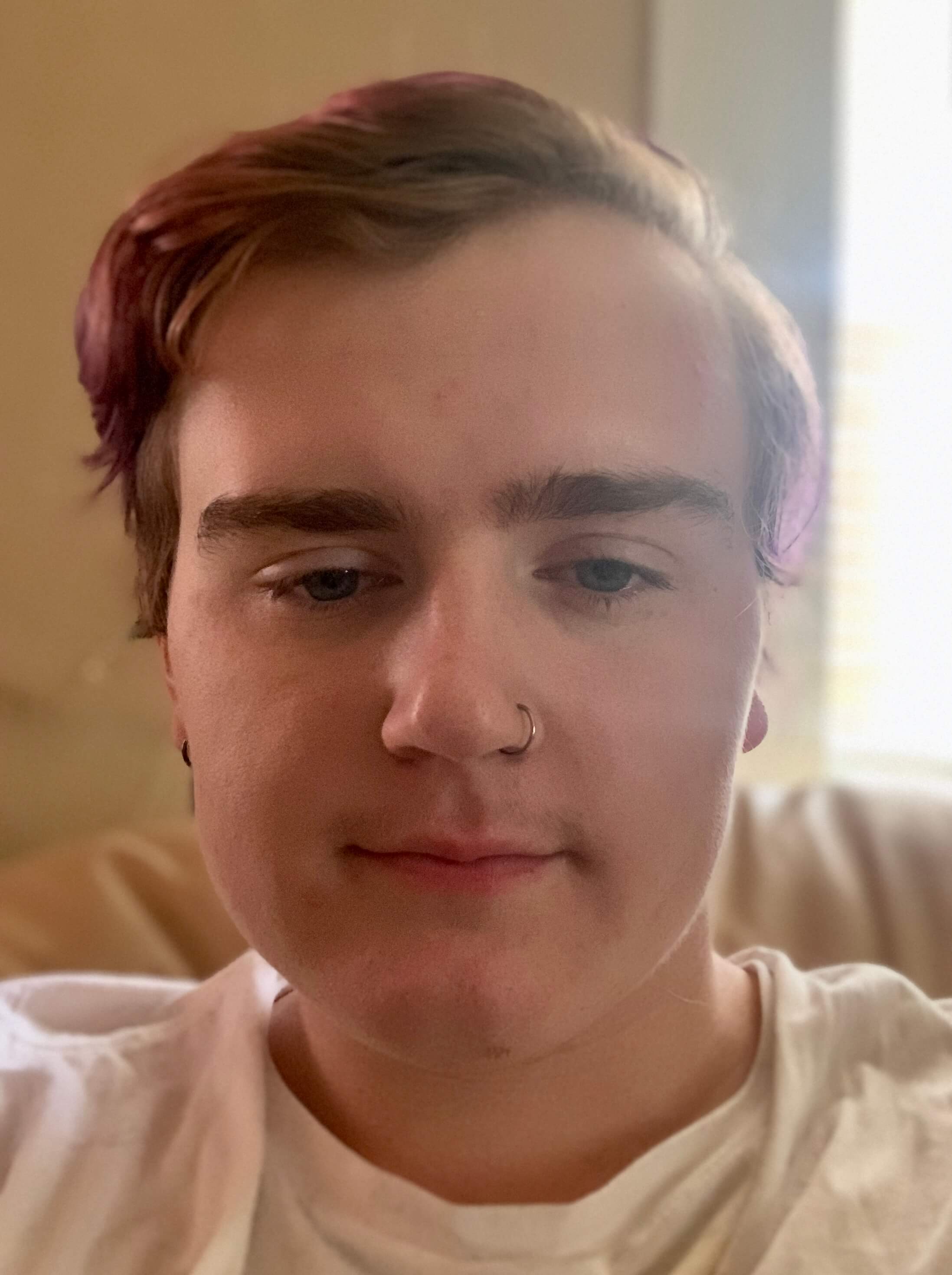

There’s a common thread that ties together the majority of my queer, tattooed friends. Most of them have at least one professionally done tattoo. But more importantly, most of them also have multiple tattoos that were either done by a friend, themselves, or maybe a stranger at a party. If they don’t have a stick-and-poke, or multiple, they’re almost guaranteed to have at least given themselves a piercing. I’m lucky in that most of my self-done piercings have turned out well, but I’ve also smiled my way through obviously infected, bump-adorned ears from which I was too proud to remove the earrings.
Some will ask if you wish to have your DIY tattoo redone professionally someday. In their minds, maybe that stick-and-poke is simply a placeholder for something better: a Real Tattoo. Yet, the answer for me and my friends? No.
The Punk Economy

The ability to adapt and self-improve through altering oneself is deeply rooted in both punk subculture and in queer identity. Punk subculture was never intended to be about $300 pre-made patch jackets or $30 studded belts. Instead, it was about changing what one had (patching destroyed grunge jeans, or holding together ripped flannel with safety pins) for both a shared aesthetic and community survival. Similarly, someone’s ability to shell out for the best artist in the state doesn’t make them better at having a tattooed body—they simply had the means to splurge on an expense that many of us can’t imagine.
While it varies shop by shop, many professional tattoo artists have a rate close to $100/hour. The cost of piercing can also be hefty, often around $30-40 plus jewelry, unless you’re going to one of the last few Piercing Pagodas dotting America’s malls. However, when I stick a piercing needle through myself in my bathroom mirror, it costs almost nothing.
Additionally, a DIY tattoo doesn’t require 6-8 hours of waiting in a shop, having a tattoo designed, and getting it inked. It happens on one’s own time, in the comfort of their own home. Similarly, there’s no need to wait behind a party of 6-year-olds who are dubiously consenting to have their ears pierced. Just stick that needle in, baby!
Beyond Economics
The rejection of DIY body modifications I’ve heard—they don’t “look good”; they’re unsafe (which does admittedly bear some truth, especially for dubious quality kits bought from Amazon); or they’re less “professional” than regular tattoos—feels like a kick in the face to the roots of queer identity in America. It seems that, very often, queer people are worried about presenting themselves to fit in with a straight, cis norm. Of course, in some cases, this is perfectly understandable. Sometimes, it is the only option we have to survive.
But other times, it seems that queer youth—myself included—are striving to reach a standard we never can. There’s pressure to be one of the “good gays”: A sanitized version who can talk about Real Housewives, or give an opinion on a Gucci bag, is a better companion to a cis, straight individual than a “dirty” queer: the studded jacket-wearing, pierced-everywhere-you-can-see queer that your grandparents will make faces at.
Empowering Bodies


According to the PEW Research Center, 38% of Americans say society has gone too far in accepting transgender people. Another 46% favor making it illegal for healthcare professionals to provide someone younger than 18 medical care related to gender transition, regardless of whether or not it’s surgery, hormones, or hormone blockers. (That’s not acknowledging that to receive gender-related care in the first place, it’s almost guaranteed that trans youth must go through extensive mental health evaluations and therapy before any true medical procedure can be performed.)
Many people who vote towards limiting health care for trans youth hold a savior complex about it. They view limiting trans health care as preventing irreversible damage to fragile children. It’s clear, though, that ‘saving the children’ isn’t really what it’s about. Instead, it’s about the erasure of a group of people who will always be seen as dirty or lesser than their straight, cisgender peers. Even when the benefits to transitioning are clear—studies have found that transgender youth who are allowed to medically transition have better mental health than trans youth who cannot pursue hormone replacement therapy (in cases where it is desired—some trans youth may not wish to medically transition). Since transgender teens are 7.6 times more likely to attempt suicide than their cisgender peers, this care can be lifesaving.
In these cases, sometimes the ability to alter one’s body with piercings or tattoos may be the only bodily autonomy they have.
A sixteen-year-old trans boy may not be able to have top surgery or go on testosterone, but he can reclaim his body with a needle and some ink. A trans girl who worked next door to me’s sole tattoo was a stick-and-poke flower behind her ear; I shudder to imagine the pain of the repetitive jabs. Although the ink had blown out and become fuzzy, she said she had no plans to cover up her first step in becoming herself. While anyone can be tattooed, the link to queer subculture can’t be denied; 51% of LGBTQ+ Americans are tattooed, while only 31% of their straight, cisgender peers can say the same. A survey performed on almost 700 transgender people with tattoos found that slightly over 10% of participants had received their tattoos to replace anatomic features or cover surgical scars; in a way, this makes the tattoo itself a form of gender-affirming care.
I am lucky in that I have the ability to largely be myself. My workplace doesn’t care if I have piercings or tattoos, although I was very thankful for the mask mandate when my nose ring became infected due to my own poor management. I attend online school, so my peers genuinely have no idea what I look like. However, based on my name, it’s easy to assume (correctly) that I’m a white man, which gives me privilege even without meeting these people.
But the future looms on the horizon. Someday, I will have to get a Real Job. I may have kids, normal-ish straight and cisgender friends: a life outside of my twenties. And I will be dragged into the future bearing all the marks of my past, from literal scars to the permanent piercing bump that mocks me from my right ear. DIY is not a shame. It’s a blessing to the art of self-expression and self-documentation. I may not love every body modification I’ve made in twenty years, but I will look back and love the past me who loved that choice with all of my heart.